
Huge Numbers by Richard Elwes
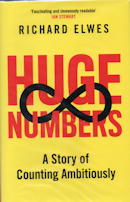 Title: Huge Numbers
Author: Elwes, Richard
Published by: Basic Books
Year: 2026
Date reviewed: 11.26
ISBN: 9781399818827
Warwickshire Libraries copy
If you expected ‘Huge Numbers’ to be a Guiness Book of Records-style collection of curiosities like ‘the prime number of the form 10001 with the largest number of zeros’ and ‘the number of seconds since the Big Bang’ you’ll be disappointed. If, on the other hand, you hoped for a scholarly but readable and entertaining exploration of numbers, counting, the various ways in which humans have developed number systems and where those explorations have taken us in cosmology, particle physics, number theory, computing and other fields up to and beyond the limits of our comprehension, then this is the book for you!
The simplest counting system is the tally – one mark on a stick, a clay tablet or anything else for each object being counted. This is fine for numbers up to a few dozen, enough for many everyday purposes. But it becomes cumbersome for larger numbers, like when you need to differentiate between 83 bags of wheat and 84. It breaks down completely for numbers in the low hundreds. A different system is needed. Elwes explores the history of numbering systems with increasing capability – Roman numerals with different symbols for 1, 5, 10, 50 etc, but hopeless for doing calculations (how many libra will LXXXIII bags of wheat cost at XLV denarii per bag? Several different cultures had systems based on 20 rather than 10 (elements of which still survive – French quatre-vingts (80, four twenties); Danish halvfjerds (70, half way to four twenties); and a few cultures tried 12-based systems.
But it was the Hindu-Arabic numeral system which eventually became the world’s standard, with its core features being a set of just ten characters, a notation where the position of a character in a string is significant, and a symbol for zero. With this system, in principle any conceivable number can be written and manipulated. However, there are limits. It’s not immediately obvious to see whether 56290471882534 is greater or less than 5696072104253, and it’s time consuming to work out. We can extend the notation slightly with the use of separators, which helps us see that 56,290,471,882,534 is indeed greater than 5,696,072,104,253 but it’s not long before this too becomes unwieldy.
To get round this problem we use two more modifications. One is to realise that we rarely need to know Elon Musk’s wealth to the precise dollar and cent, so we approximate. It’s enough to say it’s “about 947 billion dollars” or “a bit less than a trillion dollars”. We can write it as $947,000,000,000 and still have some idea of how big that is. The other modification is to introduce exponentiation using powers of ten. A million is 106, a billion is 109, a trillion 1012 and so on. So if Elon’s wealth really is nine hundred and forty-seven billion dollars we can write it as $947×109. A further modest extension is to use ‘scientific notation’ where we can express 56290471882534 precisely as 5.6290471882534E13.
This way we can handle numbers which are too big for most people to have any intuitive notion of scale. What sort of thing might need the number 1036? Elwes quotes a figure for the estimated mass of the black hole at the centre of our galaxy being 8×1036 kilograms.
Why do we need to go any further than this? It turns out that to trying to solve some of the most fundamental problems in science leads us into mathematics which generates numbers so vast that even exponentiation in powers of ten is inadequate to express and manipulate them. Here things get too esoteric for me to describe in this review, and anyway I haven’t got the software to type them on the page: I just mention ‘tetration’, where a number is raised to a power of a power. A favoured notation is Knuth’s up-arrow ↑. We’re already familiar with exponentiation, where 6x6x6 = 63 = 216. In Knuth’s notation this is 6↑3. Tetration is the next step – iterated exponentiation. 6↑↑3 means 6(66)), or 6216, a string of 216 6’s multiplied together, which I’m not going to attempt to write any other way. Beyond is pentation, 6↑↑↑3, and so on. In the final section of the book Elwes looks at some of the mathematical problems that generate these numbers which go far beyond our comprehension of size and scale.
I don’t want to leave you with the impression that ‘Huge Numbers’ is tough going and only for maths nerds – it isn’t. Elwes’ account of how humans and other species count and manipulate numbers each in their own way is fascinating. And for conceptual excess it’s hard to beat the cosmology of the Indian religion of Jainism, whose founder Rishabhanatha is said to have lived more than 1046 years ago. They also developed the concept of ‘unenumerable’ numbers, the first of which is derived by digging on a disc world a pit about a 5000 miles deep and over half a million miles wide. This pit is overfilled with mustard seeds so it forms a pile above ground some hundreds of thousands of miles high. Someone has calculated this takes more than 1045 mustard seeds. Then, taking one seed at a time, place each an exponentially increasing distance from the centre. When the final seed is placed, repeat the whole process with a new hugely larger pit, and repeat again and again as many times as there were original seeds. This is just the first of the unenumerable numbers, and it involves distances and quantities many times larger than the observable universe.
Finally, although I said at the outset this book isn’t a Guiness Book of Records-style collection of curiosities, I leave you with Jeremy Harper from Alabama, who in 2007 started counting out loud at ‘one, two, three’ and kept going all the way to ‘nine hundred and ninety-nine thousand nine hundred and ninety-nine, ONE MILLION!’ It took him 89 days. But since then his record has been beaten by Favour Ogechi from Nigeria, who reached 1,070,000 in December 2025. It took her 70 consecutive days and was streamed on YouTube.
Comments
Huge Numbers <i>by</i> Richard Elwes — No Comments
HTML tags allowed in your comment: <a href="" title=""> <abbr title=""> <acronym title=""> <b> <blockquote cite=""> <cite> <code> <del datetime=""> <em> <i> <q cite=""> <s> <strike> <strong>